Call us on 020 7183 2277
Download LATEST Market Rates >


Every Bank of England rate decision makes the news, and many borrowers time their hedging decisions around it. But Bank Rate only tells you what money costs overnight.
When you fix your borrowing costs with an interest rate swap, the price depends on what money is expected to cost over the whole term of the hedge. That price comes from the SONIA swap curve, and it can move very differently from Bank Rate.
SONIA is the overnight rate at which banks lend sterling to each other, and it closely tracks Bank Rate. Many UK floating-rate loans are priced at SONIA plus a margin.
A SONIA swap lets you exchange that floating rate for a fixed one. The fixed rate reflects where the market expects SONIA to average over the term, plus a premium for the uncertainty.
Set those fixed rates side by side for 1, 2, 5 and 10 years and you have the SONIA swap curve, also called the OIS curve. It is this curve, not Bank Rate, that tells you what certainty costs.
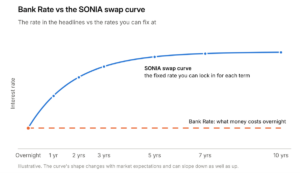
Swap rates are forward-looking. They move as soon as expectations change, often months before the Bank of England acts, and sometimes against its latest decision.
The main drivers include:
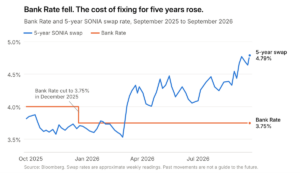
The 12 months to October 2026 show how far apart the two can drift. Bank Rate was cut from 4.00% to 3.75%, yet 5-year SONIA swap rates rose by almost a full percentage point.
Economists and the Bank of England regularly publish views on where rates are heading. These can differ sharply from what the market has already priced in.
When you hedge, you lock in the market’s price on the day, not a forecast. Waiting for a forecast to come true is a bet on the outcome, not a hedge against it.
Whatever the outlook, some situations call for early attention.
Rates rarely move in a straight line. During 2026, 5-year swap rates fell by 0.30% or more within a few weeks on several occasions, even as the overall trend was upward. Borrowers with target levels agreed and approvals in place are the ones who can act when those windows open.
Vedanta Hedging gives businesses and property investors independent advice on managing interest rate risk. We can help you:
The headline rate rarely tells the whole story. To talk through your interest rate exposure, call our team on 0207 183 2277 or visit vedantahedging.com.
This article is for general information only and does not constitute financial advice. Past rate movements are not a guide to future movements. Vedanta Hedging Ltd is authorised and regulated by the Financial Conduct Authority.